Some time ago, June 8th, 2018 to be precise, I posted here about one of my first “art ‘harps.” That autoharp creation was much like my usual custom instruments but (pun alert) highly decorated with a whimsical, tie-dyed, peace, and counter culture theme. It was quickly scooped up and shipped to a faraway continent where I hope that it is still singing amid the billabongs and coolabah trees.
Moving ahead to 2025, that first Hippy ‘Harp attracted the attention of a musician from New York who performs with autoharp and teaches music and theatre to children. She asked if I could recreate a version of that instrument.
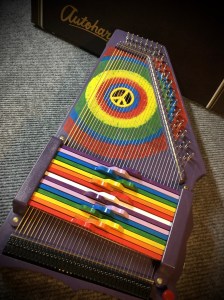
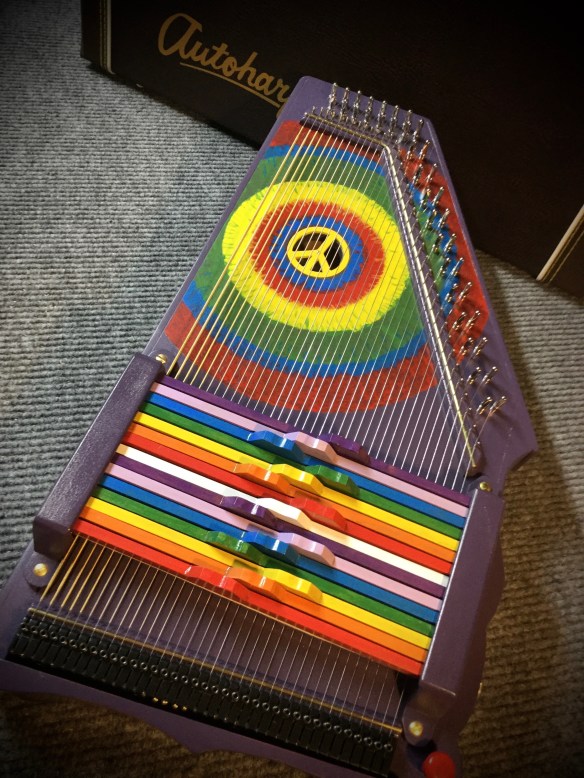 The appearance of the new Hippy ‘Harp is much the same as the original with a peace symbol rosette, tie-dyed paint job, and rainbow colored chord bars. This new version includes a solid cedar soundboard, Daigle fine tuners, and a Schreiber electromagnetic pickup.
What really sets this autoharp apart is the chord bar setup. I had begun building this instrument as a fifteen chord chromatic with the standard setup of major, minor, and seventh chords. At some point in the process I asked the musician if she might be interested in a chord system that I was just learning about, the PRIZIM.
The PRIZIM system was developed by Pennsylvanian autoharpist Loren Todd Crowley et al. With this intriguing design, a greater number of chords can be played by pressing two chord bars at a time. Hippy ‘Harp with standard chromatic tuning and fifteen conventional chord bars is mechanically the same as my other autoharps. The exception that makes this a PRIZIM is the patterns of open note cuts in each of the chord bar felts.
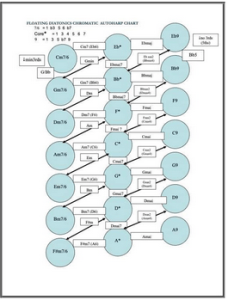
Online PRIZIM chart for 21 chord chromatic autoharp
The PRIZIM system can be adapted to almost any autoharp. Chord charts and cut patterns for twenty-one chord autoharps are available online. Because I was in the middle of building a fifteen chord instrument, I consulted with Loren for advice in using fewer bars. The result was a full compliment of two button chords in the keys of C, G, and D and dozens of combinations.
On paper, the PRIZIM’s unusual (to me) chord names and layout was confusing but once the instrument was set up, I could understand the logical layout and how easy it is to play. Chord names like stars, 6/7s, 9s, and add2s do not appear on any manufactured chord labels. For initial orientation I labeled the bars with basic chord names and provided the musician with a hand drafted chart. The experienced player should quickly grasp the logic of the system and will no longer need rely upon the labels.
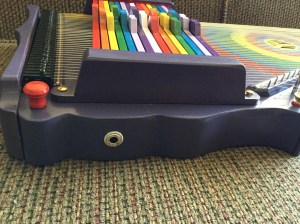

 The latest pour from the Fretnot pub is this Guinness themed auto-HARP. It was commissioned by a talented and creative musician who intends to play it in open mics at the local while singing, “Does this autoharp make you thirsty?” “Here’s some drinking songs while you enjoy a pint-or-five.”
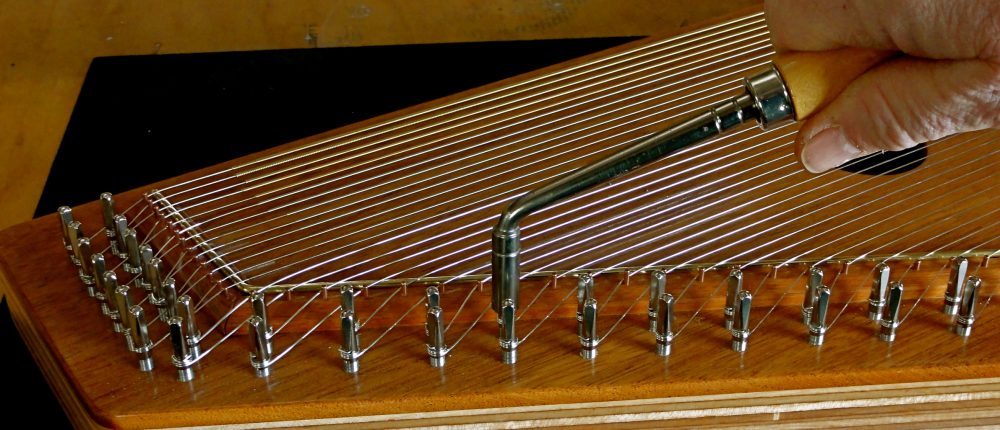
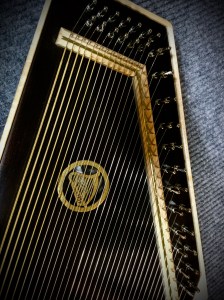 The Guinness ‘Harp is a thirty-seven string, fifteen chord G/D/A diatonic, with Daigle fine tuners and a Schreiber electromagnetic pickup. Its built upon my “A” style pinblock frame with a spruce soundboard and an Okoume plywood back.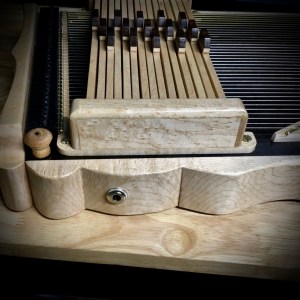
 The fifteen maple chord bar caps are dyed to match the soundboard. The bars are arranged in the three row pattern preferred by the musician.
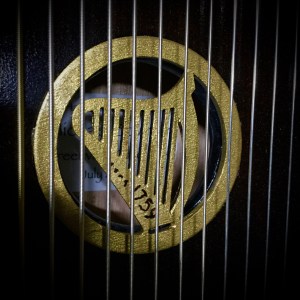 To top off this “pint o the plain” is a harp rosette painted gold.
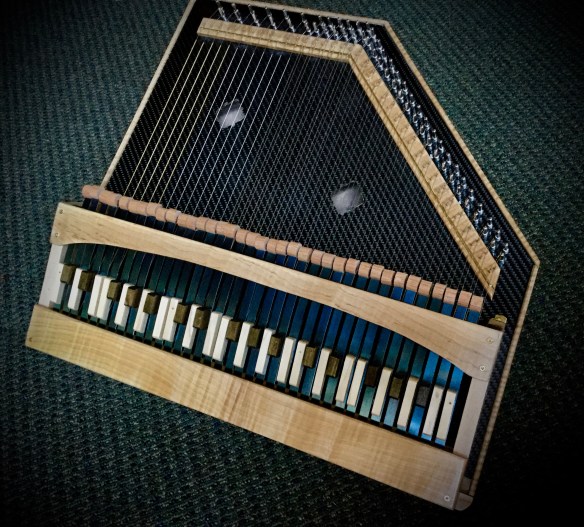 Last April I posted about the CryptoClavier, a large three octave chromatic keyboard zither that was based upon the 19th century Marxophone. This unique instrument was born from the imagination of Nashville, Tennessee musician Rory Hoffman who commissioned me to design and build it. To learn more about it you may refer to my April 2, 2025 post on this site.
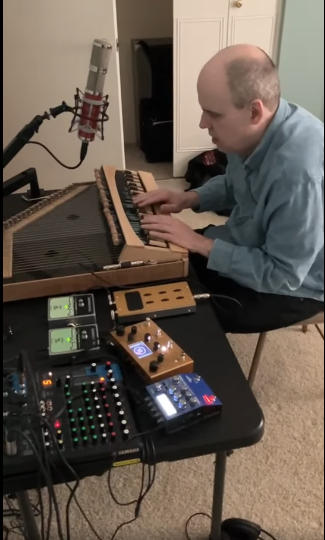 Rory Hoffman is a session musician who scores movies, plays backup on other musicians’ recordings, and performs in many local as well as worldwide venues.
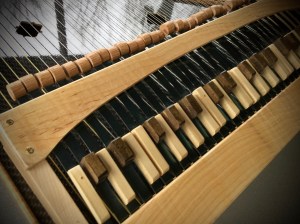 I’m looking forward to his video introduction of CryptoClavier. He has even reported that CryptoClavier will be heard on Ringo Starr’s new album to be released this April.
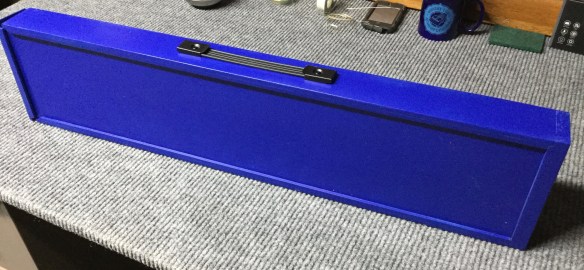 After a long wait on my “to build” list, I made this travel dulcimer as a gift for a friend of mine. He had seen an instrument like this years ago and regretted that he didn’t purchase one before the luthier passed away in 2023.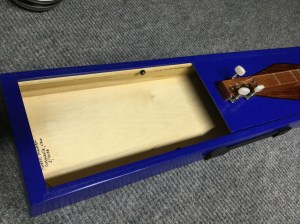
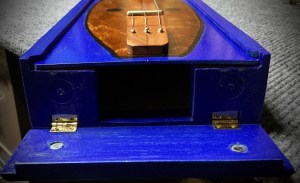 The top panel is removed by sliding it out of its channel, turned over, and returned revealing the three stringed dulcimer. Access is gained by opening a hinged door on the end of the case which is then held closed by magnets. The strings are tuned to the mode and key of choice with geared guitar style tuners. The fretboard is scaled to 23-3/8 inches and includes a 6-1/2 fret for 1-5-8 tuning (example: DAD).
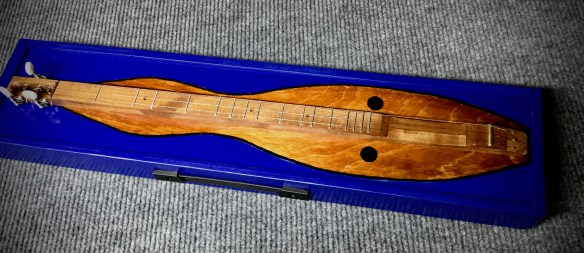 The frame of the case is made of lightweight poplar with panels made of 1/8 inch plywood. The mahogany fretboard is surrounded by a stained and painted hourglass dulcimer shape. The
 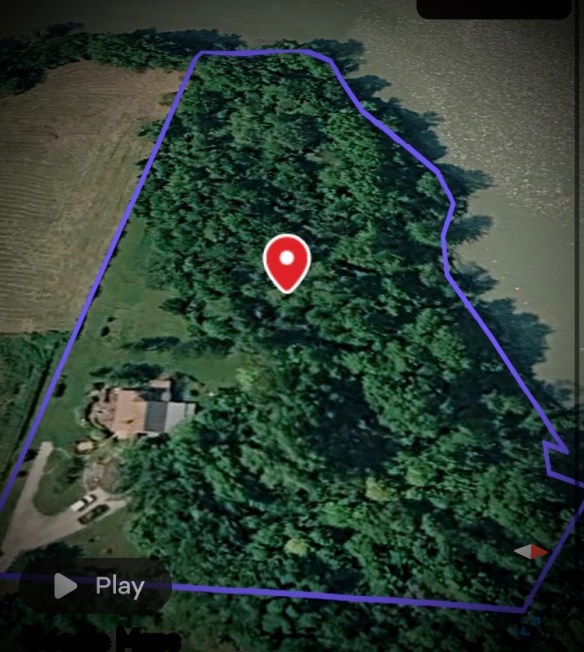 For the past 40+ years we have lived in rural Darke County Ohio along the head waters of the Wabash River. From time to time we’ve viewed satelite photos only to see a greyscale images of our wooded three acre property between farm fields and the river reservoir.
 This site has been waiting way too long for an update. In the months preceeding the present we have moved from our self-built home and workshop of 40+ years to the home and town that I grew up in. We often quip that we have “downsized” to a bigger house.
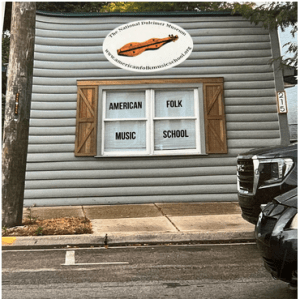 We recently visited The American Folk Music School/The National Dulcimer Museum in Trenton, Ohio. There, the owner/director Vickey Lovitt Sasser has curated a wonderful collection of Appalachian Mountain dulcimers and other stringed folk instruments. Spanning generations, over one hundred and thirty instruments tell the stories of dulcimers and their makers with examples from the early 19th century to contemporary builders.
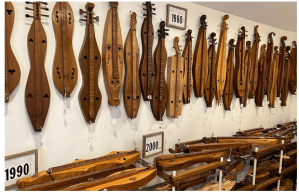 In my travels, I seek out museums that display stringed instruments and am often disappointed at meager offerings that are always behind glass. Here, we spent an enjoyable afternoon with the knowledgeable Ms Sasser examining the numbered instruments and reading about them in corresponding notebooks. Other patrons were sharing stories and some even brought their own acquisitions for Ms Sasser to identify.
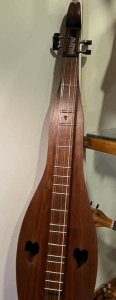 Each month the museum spotlights a dulcimer and this month it is one of mine! It seems like only forty-seven years, three months, and sixteen days since I created this all walnut hourglass dulcimer. How time flies! I am honored that one of my early dulcimers shares the museum with those of famous luthiers of the past and present.
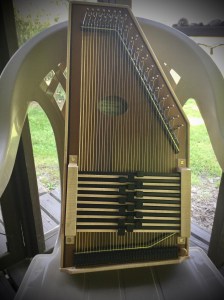 “This is the dawning of the Age of A-harpius”
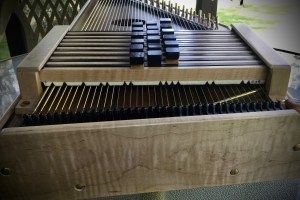 I began with my standard, one piece, pinblock frame which was extended in length to accommodate eighteen chords, an angled anchor bridge, and Daigle fine tuners. I added a 3/4 inch thick spruce spacer around the underside of the frame before attaching the soundboard, laminated back, and curly maple side veneer.
 Players with a shorter reach than this musician might find it difficult to play this deeper autoharp comfortably. To make the instrument narrower, I built it without the curved treble side that usually adds an inch of width. That, with lower chord bar covers, makes it easier to reach the buttons with the left hand.
 The solid cedar soundboard features an oval soundhole to round out the rich tone. The benefit of this deeper body with its larger internal capacity is greater volume and longer sustain.
 Having thirty-seven strings, this autoharp is set up in the single diatonic key of A. The eighteen chord bars are alternating natural maple and painted black. The musician wanted, of course, the chords in the key of A but also alternative chords that would have an ethereal feeling. For this he sought the advice of Jo Ann Smith who designs expert chord layouts and charts for cutting each individual chord. Ordinarily, a single key can be covered nicely with eight or ten chords. This instrument has fifteen chords with three additional blank bars to be cut when determined later.
 The solid spruce soundboard is colored with a blue aniline dye and decorated with a self adhesive overlay that features two dolphins leaping from the sea. The painted chord bars are profiled to resemble waves and the curly maple trim is dyed to match.
 The Okoume laminated back is painted using fish net as a stencil. A small soundhole/carry hole is decorated with a sort of alien jellyfish.
 The happy owner, Rene St. Aubin, collected his new instrument at The Mountain Laurel Autoharp Gathering which takes place each year at a university in Shippensburg, Pennsylvania. An exciting feature of the Gathering is the MLAG Autoharp Championship Contest. US and international autoharp musicians travel there to compete in this juried competition. This year Rene was a contender.
 Here is a custom autoharp commissioned by a Michigan based musician who is also an Oscar Schmidt dealer. Her Etsy site, WellsPlace, features customized new and used autoharps, therapy harps and autoharp parts and accessories.
 Her new personal instrument is a thirty-seven string two key diatonic in the keys of C and G. The fifteen maple chord bars alternate in colors from natural to stained maple.
 A laser cut rosette trims the soundhole. The dragonfly is, to date, the most popular choice and has appeared on more than a dozen of my instruments.
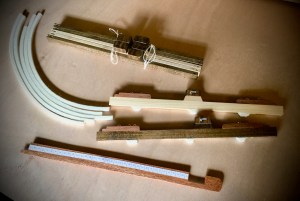 Included are C and G lock bars that can be swapped into the array as needed. The four blank chord bars and extra felt can be cut for additional chords as needed.

You must be logged in to post a comment.